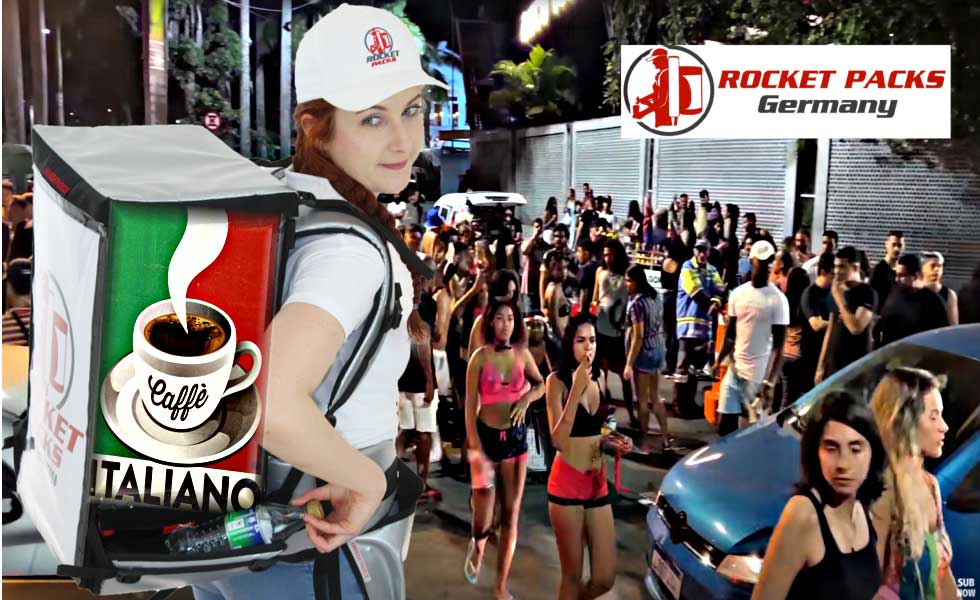
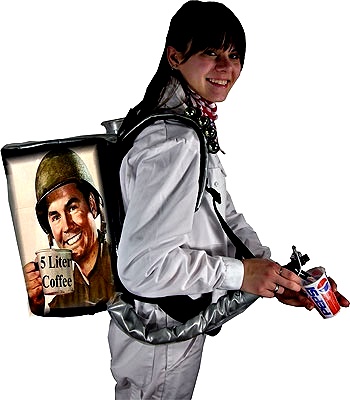
A coffee backpack makes it possible to carry prepared coffee and serve it directly in offices, exhibition halls, outdoor areas or other approved event locations. Selecting the right system depends on the beverage, required capacity, service duration and refill process. The following answers explain how mobile coffee dispensing works and what should be considered before ordering.
What is a coffee backpack?
A coffee backpack is a wearable beverage dispensing system. Prepared coffee is filled into a container inside an insulated backpack and flows through a beverage hose to a hand-operated tap.
The operator can move between guests and serve drinks away from a fixed coffee counter.
Does the backpack brew fresh coffee?
No. The backpack is a transport and dispensing system, not a coffee machine. Coffee must be brewed and prepared before it is poured into the beverage container.
Grinding beans, brewing espresso, heating water and steaming milk require separate equipment at the preparation or refill station.
Which types of coffee can be served?
The system is principally intended for sufficiently fluid beverages that can pass through the hose and tap without obstruction. Suitable applications may include filter coffee, Americano, prepared café crème, decaffeinated coffee and cold brew.
The exact recipe should be assessed when the beverage contains milk, syrup, foam, spices or other ingredients that may affect flow or cleaning.
Can freshly ground coffee be placed directly in the container?
No. Coffee grounds should not enter the beverage container, hose or dispensing tap. They can restrict the liquid path and make hygienic cleaning more difficult.
The coffee should be brewed and filtered before the container is filled.
Can espresso be produced from the backpack?
No. Espresso requires a brewing machine that forces hot water through finely ground coffee under suitable brewing pressure. The pressure used in a beverage backpack is not an espresso-brewing system.
Prepared espresso-based drinks may only be dispensed when their consistency and ingredients are compatible with the selected equipment.
Can coffee with milk be dispensed?
A sufficiently fluid prepared coffee-and-milk beverage may be technically dispensable, but dairy ingredients require particularly careful temperature control and cleaning.
The event or catering operator is responsible for defining safe preparation, holding and service procedures. Milk residue must not remain inside the container, hose or tap after use.
Can milk be carried separately from the coffee?
Yes. Serving black coffee from the backpack and providing milk separately can simplify cleaning and allow guests to adjust the drink individually.
Milk, cream, sugar, sweeteners and stirrers can be organized at a fixed service point or carried using suitable separate service equipment.
Can hot chocolate be served from a coffee backpack?
This depends on the recipe and consistency. Thin, completely dissolved beverages may flow through an appropriate system, while thick chocolate, undissolved powder or suspended ingredients may obstruct the hose or tap.
The intended product should be tested before an event. A beverage should not be assumed to be compatible only because it can be poured from a jug.
Can tea or hot water be dispensed?
Suitable still tea or hot water can be served from a configuration intended for hot, non-carbonated beverages.
Tea leaves, fruit pieces and spices must be filtered out before filling because solid ingredients can enter the beverage line.
Can the same backpack be used for cold brew or iced coffee?
Yes, an appropriate model can also be used for cold, low-viscosity coffee beverages. The drink should be chilled before filling because the backpack does not actively refrigerate it.
Ice cubes should not be placed in the container unless the selected system expressly permits this. They can obstruct the outlet or affect the dispensing process.
How does hot coffee flow from the container to the tap?
Still coffee can be dispensed by gravity in a suitable configuration. When the tap is opened, the beverage flows from the elevated container through the hose.
Additional air or CO2 pressure is normally unnecessary for a standard still-coffee application. The exact operating method depends on the selected model.
Does the coffee backpack require electricity?
No electrical connection is required for the normal gravity dispensing process. This allows the operator to move independently of sockets and fixed dispensing installations.
Electrical equipment may still be required at the preparation station for brewing, heating or refrigerating the beverage.
Does the backpack actively heat the coffee?
No. The system uses insulation to slow down temperature loss but does not contain an active heater.
The coffee must reach the required serving temperature before it is filled into the container.
How should the container be prepared for hot coffee?
A cold container can absorb heat from the beverage immediately after filling. A stainless-steel container should therefore be rinsed or preheated with hot water before the coffee is added.
The preheating water must be removed completely before the prepared beverage is filled into the system.
How long will the coffee remain hot?
No single duration applies to every event. Temperature retention depends on the backpack model, insulation, initial beverage temperature, filling quantity, ambient temperature, direct sunlight and frequency of dispensing.
A practical temperature test under the expected operating conditions is recommended before the first event.
Can boiling coffee be filled into the backpack?
The beverage should be prepared at an appropriate serving temperature and handled according to the instructions for the selected container. Extremely hot liquid increases the risk of burns during filling, carrying and dispensing.
The filling station should use controlled procedures and suitable protective measures for hot beverages.
Can the coffee temperature be checked during service?
The catering or event operator can include temperature checks in its own food-safety procedure. Measurements should be taken using suitable hygienic equipment.
The backpack itself does not include a standard digital temperature display.
What happens when the container is only partly filled?
A lower filling quantity reduces the total weight carried by the operator but can also result in faster temperature change because less hot beverage is present inside the container.
The filling quantity should therefore be selected according to expected demand, carrying comfort and the planned distance to the refill station.
Which container size is suitable for coffee service?
A smaller container may be practical for short service periods, sampling portions or frequent refilling. A larger container reduces refill frequency but creates a higher loaded weight.
The choice should consider the serving size, expected number of drinks, walking distance and physical capability of the operator rather than capacity alone.
How can the number of servings be estimated?
Divide the actual filling quantity by the intended cup volume. Then allow for test dispensing, incomplete servings and a small residual quantity remaining in the system.
Very small sampling cups produce more portions but also require more individual serving actions.
Which cups can be used?
The cups must be suitable for the temperature of the beverage and stable enough for mobile service. Disposable or reusable cups may be used depending on the event concept.
When an attached cup dispenser is required, the cup rim diameter and shape must be compatible with the dispenser. Cups with handles or unusual rims should be checked using a sample.
Should lids be fitted before or after dispensing?
This depends on the planned service process. For hot beverages, lids are normally fitted after the cup has been filled so that the operator can see the fill level.
Lids should be stored hygienically and positioned so that they do not interfere with the tap, hose or movement of the wearer.
Where can sugar, milk and stirrers be carried?
These items are not automatically stored inside the beverage backpack. They may be provided at a separate service point, carried by another employee or organized in suitable external service accessories.
The workflow should avoid placing open ingredients where they can contaminate the tap or beverage hose.
Where can mobile coffee dispensing be useful?
A coffee backpack can supplement fixed beverage stations where guests are distributed across a larger area or need to be approached directly.
- Trade fairs and exhibitions
- Conferences and hospitality breaks
- Corporate events
- Outdoor promotions
- Film and production locations
- Queues and waiting areas
- Sampling and brand campaigns
- Private events with professional catering
The venue operator must approve the serving area and keep emergency routes and narrow passages clear.
Can the backpack replace a complete coffee bar?
Usually, the mobile system works best as an additional service point. A preparation station is still required for brewing coffee, storing ingredients, refilling containers and cleaning equipment.
The backpack can bring prepared drinks to guests but does not replace all functions of a staffed coffee bar.
How should a refill station be organized?
The refill area should be separated from visitor traffic and provide enough space to remove, place and refill the backpack safely.
Useful equipment may include:
- Freshly prepared coffee
- Suitable filling jugs or funnels
- Clean replacement cups and lids
- Milk, sugar and stirrers
- Cleaning and wiping materials
- A stable surface for the backpack
The beverage container should normally be removed or positioned securely before it is opened and refilled.
Can the backpack be refilled while it is being worn?
No. Filling hot liquid into a container while it is on the operator’s back creates an unnecessary risk of spilling and burns.
The backpack should be removed and placed securely at the preparation station before the container is opened.
How should staff be trained?
Every operator should practise with the filled system before serving guests. Training should include safe lifting, harness adjustment, walking, tap operation and returning to the refill station.
Staff should also understand how to respond to leaks, slow flow, an empty container or an unexpectedly hot external component.
How should the backpack fit the wearer?
The shoulder straps and waist belt should be adjusted so that the filled unit sits close to the body and does not move excessively while walking.
The fit must be tested at the planned operating weight. An adjustment made with an empty backpack may not be suitable after filling.
Why does coffee sometimes flow slowly?
A slow or interrupted flow may be caused by a restricted hose, a partially closed tap, residue in the liquid path, an incorrectly positioned container or insufficient pressure equalization in a gravity system.
The unit should be removed from service while the cause is inspected. Additional pressure should not be applied to a system that was not designed for it.
What can block the dispensing tap?
Coffee grounds, undissolved powder, spices, thick syrup, milk residue and dried beverage deposits can restrict the tap or hose.
Filtering the beverage and cleaning the complete liquid path immediately after use reduce the risk of blockages.
Can different coffee varieties be served from one backpack?
Different products can be used at separate times after the container, hose and tap have been cleaned thoroughly.
Assigning one backpack to each variety may be more practical when regular, decaffeinated and milk-based drinks are offered simultaneously.
Can coffee and tea be changed during the same event?
A product change is possible only after the previous beverage has been emptied and the liquid path has been rinsed or cleaned appropriately.
Changing beverages without cleaning can transfer flavour, aroma and allergens into the next drink.
How should the system be cleaned after black coffee?
Empty the remaining coffee before residue can dry. Rinse the container, hose and tap with clean water so that the complete beverage path is treated.
Use a suitable beverage-system cleaning product when required, following its instructions. Rinse all components thoroughly afterwards and allow them to drain and dry.
Does coffee with milk require a different cleaning procedure?
Milk-containing residue requires immediate and particularly thorough cleaning. The container alone is not sufficient; the hose, fittings and internal tap passages must also be treated.
The operator must apply an appropriate food-hygiene procedure for dairy beverages and ensure that no residue remains before storage or another product is filled.
Can cleaning be postponed until the following day?
This is not recommended. Coffee, milk, sugar and syrup residues can dry inside the beverage path, affect flavour and make later cleaning more difficult.
The system should be emptied and cleaned promptly after the service period.
How should the backpack be stored?
Store the system empty, clean and dry. The container should not be closed while moisture remains trapped inside.
The hose and tap should be positioned without sharp bends, and the backpack should be protected from dirt, direct heat and unnecessary pressure on the insulated cover.
Can promotional graphics be displayed?
Depending on the selected model, printed paper graphics can be inserted behind transparent display surfaces. This allows the design to be changed for different coffee brands, sponsors or events.
The correct dimensions should be confirmed before the artwork is prepared. Graphic design and printing are not automatically included.
Can the backpack be used for free product samples?
Yes. Mobile dispensing can be used for small tasting portions as well as regular beverage service. The cup size, expected sample quantity and refill frequency should be considered when selecting the container.
The organizer remains responsible for food hygiene, ingredient information, allergens and any permissions required at the location.
What information is required for a coffee backpack quotation?
Please describe the beverage and the complete planned service process. Useful information includes:
- Required number of backpacks
- Type of coffee or other beverage
- Black coffee or milk-based drink
- Hot or cold service
- Preferred container capacity
- Expected cup or sample size
- Cup rim diameter and shape
- Length of each service period
- Indoor or outdoor application
- Required accessories
- Required advertising surfaces
- Event date or requested delivery date
- Delivery country and postal code
If no model has yet been selected, explain where the coffee will be prepared, how frequently the backpack can be refilled and how far the operator must walk. This information helps identify a suitable available configuration.